
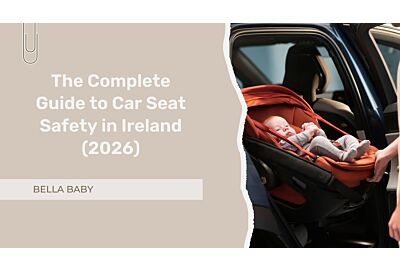
The Complete Guide to Car Seat Safety in Ireland (2026)
Choosing the right car seat is one of the most important decisions you'll make as a parent. Whether you're bringing your newborn home from hospital, moving your toddler into their next-stage car seat or wondering when your child can safely use a booster seat, it can feel overwhelming.
With different types of car seats, changing regulations, safety standards such as R129 (i-Size), and lots of advice online, knowing where to start isn't always easy.
At Bella Baby, we believe parents deserve clear, accurate information they can trust. That's why we've created this complete guide to car seat safety in Ireland, explaining Irish car seat laws, R129 and i-Size, rear-facing, ISOFIX and how to choose the right car seat for your child.
Throughout this guide, we'll reference the latest guidance from the Road Safety Authority (RSA) and explain what it means in simple terms.
Please note: This guide is for general information only. Always follow your car seat manufacturer's instructions and consult your vehicle handbook for installation guidance.
Why Car Seat Safety Matters
Every journey, no matter how short, carries some level of risk. A correctly fitted and appropriate child car seat dramatically reduces the risk of serious injury in the event of a collision.
According to the Road Safety Authority (RSA), using the correct child restraint is one of the most effective ways to protect children travelling in cars. A car seat must be suitable for your child's height and weight, fitted correctly and used on every journey.
Many injuries occur not because a car seat is poor quality, but because it has been installed incorrectly or the child has not been secured properly. That's why choosing the right seat is only part of the process. Correct installation and everyday use are just as important.
At Bella Baby, we encourage parents to ask questions, seek advice and have their car seat checked whenever possible.
Car Seat Laws in Ireland: What Does Irish Law Say?
Under Irish law, children must use an appropriate child restraint while travelling in a vehicle until they are 150 cm in height or 36 kg in weight, whichever comes first.
The restraint must:
• Be suitable for your child's height and weight.
• Meet recognised European safety standards.
• Be fitted according to the manufacturer's instructions.
• Be used correctly on every journey.
This legislation is designed to ensure children remain properly protected until an adult seat belt fits them safely.
EXTERNAL LINK: Read the Road Safety Authority's Child Safety in Cars guidance
Are There Exceptions?
Irish law provides limited exceptions in certain situations, such as:
- Licensed taxis where an appropriate child restraint is unavailable.
- Unexpected journeys over short distances.
These exceptions are limited and should never be considered the safest option. Whenever possible, children should always travel using an appropriate child restraint.
Understanding Car Seat Safety Standards: R129 and i-Size
If you've been shopping for a car seat, you've probably seen terms such as R44/04, R129 and i-Size.
It can be confusing, so here's a simple explanation.
What is R129?
R129 is the latest European safety standard for child car seats.
You may also hear it referred to as i-Size, although not every R129 seat is officially i-Size compatible.
Compared with older standards, R129:
✔ Uses your child's height rather than weight to help choose the correct seat.
✔ Requires improved side-impact protection.
✔ Encourages children to remain rear-facing for longer.
✔ Uses more advanced crash testing.
Since September 2024, new child car seats sold within the EU must comply with the R129 regulation.
What is i-Size?
i-Size is part of the R129 regulation.
An i-Size seat is designed to fit vehicles with approved ISOFIX seating positions and meet strict testing requirements.
Benefits include:
- Easier installation
- Reduced risk of incorrect fitting
- Better side-impact protection
- Height-based sizing
- Improved compatibility
How to Choose the Right Car Seat for Your Child
Choosing the Right Car Seat
One of the biggest mistakes parents make is choosing a seat based only on age.
Age is useful as a guide, but your child's height, weight and development are much more important.
Choosing a Newborn Car Seat
Newborn to Around 15 Months
Recommended seat: Rear-facing infant carrier.
These seats provide excellent protection for a baby's head, neck and spine. Many infant carriers can also attach directly to compatible travel systems, making them a popular choice for new parents.
INTERNAL LINKS HERE:
Shop Newborn Car Seats
Shop Travel Systems
Choosing the Next-Stage Car Seat
Around 15 Months to 4 Years
Many families move to:
- Extended rear-facing seats
- Rotating car seats
- Convertible seats
Whenever possible, we recommend keeping children rear-facing beyond the legal minimum, as it offers greater protection during a frontal collision
Choosing a High-Back Booster Seat
Around 4 to 12 Years
Children usually transition into:
High-back booster seats.
These help position the adult seat belt correctly across the child's shoulder and hips while providing additional side-impact protection.
Why Rear-Facing is Safer?
One of the biggest advances in child passenger safety is the move towards extended rear-facing travel.
When a child travels rear-facing, the shell of the car seat supports their head, neck and spine during a collision.
In a forward-facing seat, much greater force is placed on the child's developing neck.
Safety experts across Europe recommend keeping children rear-facing for as long as their seat allows.
Many modern seats now allow children to remain rear-facing until approximately 105 cm or even 125 cm, depending on the model.
Common Myth "My Child Looks Uncomfortable Rear-Facing"
Children are naturally flexible.
Bent legs do not mean a child has outgrown a rear-facing seat.
Height limits and manufacturer guidance- not leg position - determine when it's time to move to the next stage
Need Help Choosing the Right Car Seat?
At Bella Baby, we're committed to helping parents make informed decisions about child car seat safety. Our experienced team can guide you through the different options, explain the latest safety standards and help you find a seat that's suitable for your child, your vehicle and your family's lifestyle.
Whether you're expecting your first baby or choosing the next-stage seat for a growing child, we're here to help every step of the way.
There is no silly question when it comes to car seat safety. Whether you're choosing your baby's first car seat, moving to the next stage or simply want reassurance that you're making the right choice, our team is here to help.
or
Visit Bella Baby In Store for Expert Car Seat Advice